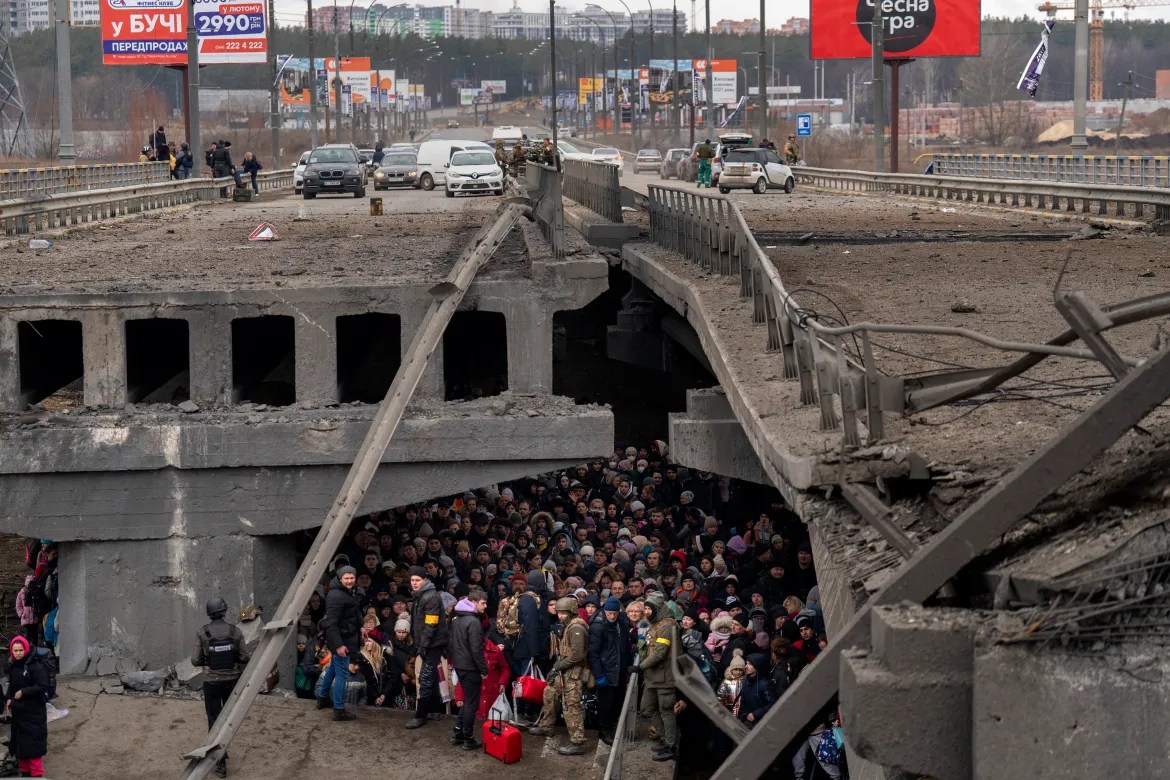
It has been three years since the festering conflict in Ukraine turned into a full-scale war of survival. While I have closely followed the lead-up to February 2022 and much of the developments since, I have not yet provided detailed thoughts about it, partly because I am not as learned on Russia and Eastern Europe as I am about the Asia-Pacific, and partly because much of the discourse is already filled by those who are.
But as we reach the three-year mark in a war that has become grueling and attritional, there is perhaps a need to remind ourselves that the constant battle in the information space is fiercer than ever. Propaganda is the cheapest form of warfare to wage.
Over these few years, I have observed the narratives surrounding the conflict, how to best unpack and respond to them, and more importantly—to understand that this is a nakedly irredentist and imperialistic conflict, and to not lose this in the attempts of one side to muddy this ambition.
To be upfront about my position, angle, or biases:
- I have a deep and enduring appreciation of Russian literature, art, the contributions of Russian scientists to humankind, and even the fascinating intricacies of the Russian language itself, который я усердно пытался изучать на протяжении многих лет.
- I also consider the current Russian government to be an active drain on human progress and a self-defeating regime that does not only contribute to but actively initiates the suffering of the Russian people—all for the sake of a hubristic dream to return to a world of untroubled imperialism.
Here are the main Russian narratives over the past few years:
Narrative 1: Russia requested the United States and NATO to stop expanding for years and decades.
Narrative 2: The US continuously sought to destabilize Russia by fostering color revolutions at its periphery.
Narrative 3: Russia finally invaded in order to achieve concessions on Ukrainian neutrality.
Narrative 4: Ukraine is a neo-Nazi / Banderite regime that Russia had the responsibility to intervene against.
Narrative 1: Russia requested the United States and NATO to stop expanding for years and decades.
NATO expansion since the end of the Soviet Union came at the explicit request of Eastern European countries, which had aspired to join since the 1990s. Many were in fact partially driven by Russian actions in the Chechen Wars, when it became clear that actions by the new Russian Federation were eerily similar to the Soviet Army that they were all too familiar with.
Even then, the most relevant round of NATO enlargement occurred in 2004 (which included the Baltic countries), well before any recent expansions or any actions surrounding Ukraine. If there was a time for understandable Russian malcontent over NATO, it should have been here, where NATO assets could be stationed within ~90 miles of St. Petersburg. However, this overlooks two issues:
- That the Russian sense of security is more important than the wishes of three sovereign nations.
- That NATO, led by the US, was interested in subduing Russia right at the peak of Western focus on the Middle East.
On the second point: Before the refocus on great power competition in recent years, Western countries were acutely concerned about bringing more partners onboard against terrorist groups. More importantly, US forces were heavily reliant on a friendly Russia to provide air access into land-locked Afghanistan – a direct route from North America into Afghanistan is impossible without Russia’s permission to use its airspace.
A similar Russian claim is that NATO encouraged Ukrainian candidacy. The first issue here is that NATO’s open-door policy existed well before Ukraine became more pro-West. If Ukraine, a sovereign European country, wanted to join NATO, the alliance could not change its entire policy just for the circumstances of one country. Russia might as well have requested NATO to dissolve itself, which might have been a more intellectually honest proposition.
But the real kicker? Before 2022, Ukraine would never have likely been accepted into NATO due to the messiness of the Donbas conflict and the status of Crimea. Before 2022, some NATO members were even openly questioning the alliance’s purpose.
Then, Vladimir Putin directly gave NATO a renewed life and purpose. It gave Finland and Sweden express reasons to break neutrality and expand Russia’s direct borders with the alliance. It turned Emmanuel Macron – one of the most stringent pan-Europeanists in recent memory who attempted to bring Russia into the European fold – into one of the hardest voices against Russian victory in Ukraine. If Putin was genuine about NATO being the root issue, this would be one of worst geopolitical self-defeats in history.
However, if we do not want to label Vladimir Putin as a blatant fool, then the logical reverse should be applied: Putin was never genuine about NATO being the core issue at hand.
Narrative 2: The US continuously sought to destabilize Russia by fostering color revolutions at its periphery.
The notion that the US, whilst trying to rid itself of messy engagements in the Middle East and reduce its budgetary commitments to Europe whilst refocusing its diplomatic and state institutions on countering China, decided to destabilize parts of Europe (for the off chance that it could be helpful to US interests) is unconvincing.
Geopolitically, there was no guarantee that a pro-European Ukraine would be beneficial to US interests. Kyiv, above all, desired closer relations with the EU for its economic benefits, but it was still notably friendly with China and sought to maintain relations with other US adversaries like Iran. It must be reasserted that China and Ukraine had strong relations before 2022 with a number of major Chinese and Belt and Road projects active in Ukraine up until Russia’s invasion, including agriculture, solar energy, and port constructions. Even after 2014, Ukraine also continued to provide China with military equipment, including engines for tanks and aircraft. These relations would not have changed if Ukraine was in the EU – in all likelihood, Beijing would have significantly benefited from the addition of a pro-China EU member state to influence European policies.
Domestically, entire US institutions were paralyzed after the Bush years by the fear of blowback, ranging from influential academics and populist politicians on both sides of the aisle. The Obama administration was afraid of leading the intervention in Libya and afraid of supporting the Syrian rebels until Daesh emerged. More pertinently, the administration was criticized for refusing to provide lethal aid to Ukraine, and behind the scenes, the CIA was afraid of assisting the Ukrainians right after the events of 2014 due to a lack of trust and fears of Russian reprisals. It was not until the first Trump administration that Javelin anti-tank systems finally began to make their way to Ukraine – and even then, these man-portable systems are largely more suited for defensive scenarios.
These are not actions that reflect a consistent and enduring scheme to destabilize Russia. The same administration that supposedly fostered a Ukrainian color revolution, just mere years after it aimed to reset relations with Russia so that it could pivot to Asia, evidently failed to follow up on the momentum of their success.
Even if we were to assert that there was indeed an actual US policy framework to incite and fabricate events like Euromaidan, it would be akin to throwing a dart, not caring if it hit the target, and completely forgetting about where it landed.
Narrative 3: Russia finally invaded in order to achieve concessions on Ukrainian neutrality regarding NATO.
There are public records that the US and Russia had multiple negotiations in the months and weeks before the invasion. The US was proactively willing to concede on some things, including reducing military cooperation with Ukraine.
However, Moscow counter-offered by wanting NATO to ‘fully withdraw from eastern and central Europe‘. This was not a mere request for NATO to move units away from the Russian border, it was demanding the alliance to leave these countries – full NATO members – wholesale. Moreover, it demanded that all US intermediate ballistic missiles should be extricated from Europe, creating a deterrence gap that could not be filled by European NATO members alone. The final qualifier added by Russian diplomats was all of these demands were to be taken at once: they were all or nothing, with zero intent to have piecemeal negotiations on each demand.
No matter how strongly one might feel about these maximalist requests, any understanding of NATO would dispel most from the notion that anything other than automatic rejection would be the immediate reaction. And thus they were rejected, but not without a final set of offers on February 2: These included additional negotiations on preventing the deployment of further offensive systems in Ukraine along with the US also proposed limiting missile deployments, while paving the way for Russian visits to missile sites to increase transparency and verification.
As Alexander Gabuev from the Carnegie Russia Eurasia Center recounts, Russian diplomats were pleasantly surprised by the final proposal and were even preparing to negotiate in Geneva for several more months – but by then, there were overridden by the Kremlin – a decision not discussed or agreed upon by the diplomatic service:
“As Gabuev sees it, it would have been possible at that time, for the Kremlin to score a big diplomatic victory, albeit by dint of some blackmail, but Putin had already decided to go to war, and so, in the end, talks with NATO were just a smokescreen.”
The final offers were rejected, and within days of the conclusion of the Beijing Winter Olympics, Russia invaded Ukraine.
We thus return to the point about Vladimir Putin never being serious about NATO as the root issue. The greatest threat provided by NATO’s mere existence is its constraints on Russia’s own ability to expand and incorporate Ukraine into Russia. We can only suppose that to him, anything that inhibits these imperial ambitions is a security threat.
To truly elucidate this point, let us review something published by Russian state media three days into the invasion.
“The Advent [or Arrival] of Russia and the New World” was posted on February 27, 2022, before being deleted (the link directs to an archived version). In it, it states that “Ukraine has returned to Russia” and that Putin had established a “new Russian world order” with Russia, Belarus, and Ukraine. It also says:
Владимир Путин взял на себя — без капли преувеличения — историческую ответственность, решив не оставлять решение украинского вопроса будущим поколениям.
“Vladimir Putin has assumed — without a drop of exaggeration — a historic responsibility by deciding not to leave the solution of the Ukrainian question to future generations.”
The article was published at exactly 8:00 AM – the dawn of the third day of the invasion – which indicates it was likely written well in advance and posted automatically in expectation of Kyiv falling to Russian forces by then. A translated version in English was also prepared that made its way to Pakistani news wires before being deleted, indicating it was intended for global reach.
In this article, it talks little about NATO and more about the broader cultural forces of ‘Anglo-Saxons’ and the West. It castigates Ukraine not just because it sought closer ties with the West, but because they were ‘Little Russians’ to begin with all along. The particular term, also used as Malorossy, is a distinctly anachronistic derogative that harkens back to Imperial Russia, and was even repurposed by nationally conscious Ukrainians as early as the 18th century to designate Ukrainians solely loyal to the Tsar (Kappeler, p14). It is a term that both denies the Ukrainian identity whilst propagating their subservient relationship with Russia. If there was a description of hubris, it would be this article.
It would be impossible to raise this article without understanding it as a follow-up to a 7,000-word essay penned under Putin’s name from July 2021, just as Russian battalion groups were beginning to coalesce around Ukraine. Titled “On the Historical Unity of Russians and Ukrainians”, the piece denounced the concept of Ukrainian statehood (in addition to Belarus), alleging it was an entity that was regretfully fabricated in the 1920s by Vladimir Lenin and certain Bolsheviks under Austro-Hungarian influence. This conveniently ignores the hundreds of years of Ukrainian national consciousness, the slew of different Ukrainian-identity factions in existence before the 1920s (ranging from republicans, anti-Bolshevik social democrats, to anarchists), and even its independent post-Soviet existence.
Putin’s article has many more aberrations to mention, but he betrays a clear and simple point — in order to justify Russian actions around Ukraine, he could only opt for a mixture of altered history and Russian chauvinism, soaked in the naked hubris of imperial ambition.
This brings us to our final narrative.
Narrative 4: Ukraine is a neo-Nazi / Banderite regime that Russia had the responsibility to intervene against.
The portrayal of Ukraine as a neo-Nazi state is one of Russia’s most interesting claims, as it holds up better for domestic consumption rather than international legal processing. It also follows a uniquely Russian perspective of the term “Nazi” — not one that perceives it as inherently fascistic or anti-Semitic, but something simply anti-Russian — a notion shaped by the horrors of the Eastern Front of World War 2, or as known in the USSR, the Great Patriotic War.
Let us review the realities: While Ukraine, like many countries, has had far-right elements, they did not hold significant political power by 2022. The far-right party Svoboda failed to win any seats in the 2019 parliamentary elections, while also failing to win the support of any larger party through its existence. Another decisions made by Ukrainian voters in 2019 was to elect Volodymyr Zelenskyy, a Russian-speaking Jewish president (whose grandfather fought in the Red Army against the Nazis), in a landslide 73% victory. Even before 2022, Kyiv had distanced itself from radical nationalism in mainstream politics and denounced actions by far-right groups, particularly understanding that these could feed Russian narratives and weaken support from the EU.
As for the term “Banderite”, this refers to Stepan Bandera, a far-right nationalist figure that sided with the Nazis against the USSR in World War 2. While Bandera’s legacy is debated within Ukraine, with some seeing him as a nationalist leader resisting Soviet oppression and others condemning his collaboration, modern Ukraine does not operate under a Bandera-style ideology. There can be an argument made that the continued presence of far-right groups who glorify figures like Bandera is unacceptable, but such arguments stop short of giving validity to claims that the Ukrainian state and society had become far-right.
A rough analogy could perhaps be that of how the Confederate States and its leaders are still revered by a few parts of the southern US — some see it as a brave resistance, while (most) others see it as an evil of the past. Yet, even for those strongly against the Confederacy, it would be odd to advocate for the modern and violent invasion of places like Mississippi and Alabama and punishing their civilian populations.
This is what was proposed by another state media article in April 2022: “What Russia Should Do with Ukraine”, which claimed that the majority of Ukrainian civilians were already Nazis, thus requiring forced labor, death penalties, and mass imprisonment as punishments. It interestingly also raised that Banderites are a marginal smokescreen compared to the even less-defined concept of “Ukro-nazis”, and that their true terrifying purpose is to have Ukraine… become more European. A horrifying concept, that according to the article, requires the “de-Europeanization” of the country.
In light of this, some might still take a reductionist position that this is merely a conflict fought between two nationalistic entities. Yet, surges in Ukrainian nationalism should of be no surprise when viewing Russia’s actions since 2014, and more obviously, since 2022. One can hardly be shocked when a country’s nationalism increases in response to a larger neighbor clamoring for their territory and sovereignty, as recent weeks have demonstrated on another continent.
As one historian on Russian and Soviet history commented in the weeks after the 2022 invasion:
“It is precisely because of the war in eastern Ukraine, which has been raging since 2014, that Ukraine has become a largely united country. Putin has done more for Ukrainian nation-building than anyone else.”
Let us zero in on one final data point to encapsulate the absurdity in its totality.
As Putin was on the eve of a the largest land war in Europe since the Great Patriotic War, his speech conveyed a sense of dire urgency, as if the government of Ukraine was culminating in an escalating and devastating campaign of genocide against Russian speakers in Donbas.
As it turns out, the total number of civilian deaths in Donbas (from both sides) in the entire calendar year before the 2022 invasion, was a grand total of 25 as reported by UN – a report also recognized by the Russian government. Any civilian casualty is a tragic occurrence, but as the report noted, this was a 26.2% decrease compared with the previous year while being the lowest annual civilian casualties for the entire conflict period.
It is thus even more tragically absurd that Russia, in order to prevent these few dozen casualties from continuing, opted for a the closest modern analog to total conventional war, costing hundreds of thousands of pro-Russian lives, including that of service members and civilians in Donbas. It is thus even more tragically amusing to compare Ukraine to the Nazis, as if Kyiv’s desire to maintain Donetsk, Luhansk, and its internationally recognized borders is the modern equivalent of the Wehrmacht slicing into Russia to siege Leningrad, Moscow, and Stalingrad.
It is thus almost, just almost, as if these were deeply flawed and unserious claims — yet were also their only avenue of justifying it to those susceptible few who are not on board with the Russian imperial project.
 The Constant