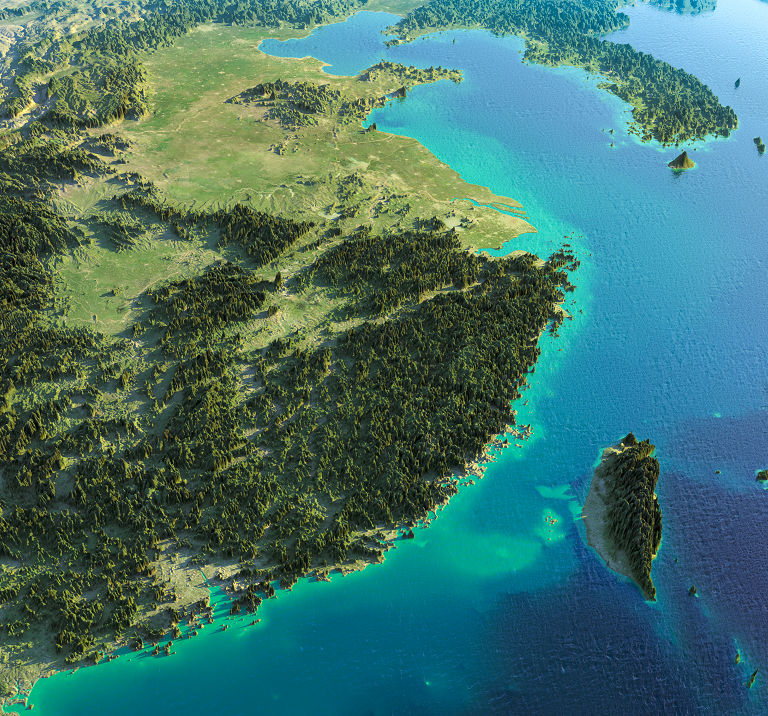
Short answer: Very low, unless one of either Beijing or Taipei loses all sense of rationality.
Longer overview:
The general US and allied perspective is that Beijing would be the first to initiate a potential armed conflict that might drag the US into joining, and that this would most likely be caused by an attempt to take Taiwan by force.
- On the SCS: While there are also risks of a conflict emerging from escalated hostilities in the South China Sea, Beijing’s messaging is far more acute towards Taiwan, and much of its diplomatic efforts are geared towards asserting a maximalist claim over the island, far beyond its attempts to assert its claims in the SCS.
From the Chinese perspective, the onus would be on Taipei to initiate the grounds for any conflict, giving Beijing the casus belli to, at minimum, officially threaten the use of force. This would, from their perspective, be caused by a formal attempt by Taipei to declare independence.
- Quick Review: For decades, Beijing, Taipei, and Washington have all agreed that the foundation for cross-strait peace is the recognition that both governments are part of ‘China’ in one way or another.
- Beijing has repeatedly asserted that a Taiwanese declaration of independence from this concept of ‘China’ would be the precise trigger for open hostilities. Generally speaking, Taipei has always respected this trigger / red line.
- Moreover, the official US position is against a unilateral Taiwanese move towards independence. While the US tries to strike a balance between committing to a security guarantee for Taiwan or not (strategic ambiguity), it has always been clear about this.
- However, the pro-independence party (DPP) tends to pursue things that Beijing would label as microaggressions: shrinking the name ‘Republic of China’ on passports in favor of enlarging the word ‘Taiwan’, changing ‘ROC National Day’ to ‘Taiwan National Day’, and so on. None of this would be a formal or legal change to the country, but these are nevertheless actions to reinforce a unique Taiwanese identity.
For some Chinese hardliners, the fear is that Taiwan’s population will see themselves completely foreign from the concept of ‘China’. This is indeed occurring – Taiwanese, particularly younger generations, are gradually trending towards rejecting ‘Chinese’ as their self-identity. However, identity does not always neatly match with political positions.
Taidu vs. Huadu: A Taiwanese declaration of independence would require overhauling its constitution and ending the political continuation of Sun Yat-sen’s Republic of China. In many ways, Taiwan would not be declaring independence from the PRC (which it was never part of), but from the ROC.
- To get around this, a more moderate approach to independence tends to be adopted by DPP politicians as they gain power. In the early career of William Lai, the current president-elect, he heavily advocated for full Taiwanese independence, before moderating his views to be similar to that of President Tsai Ing-wen: Taiwan, as the Republic of China, is already legally and functionally an independent country from the People’s Republic of China.
- This is known as Huadu (華獨), a recognition that Taiwan is already independent, as opposed to Taidu (臺獨), which asserts that this form of independence is not enough.
- Beijing tends to be neutral on the concept of Huadu, while it is completely opposed to Taidu.
Taipei, even if it were under very strong DPP control, has no immediate incentive to formally pursue Taidu.
- Taiwan is already quite developed, benefits from stable global trade, and is not barred from having unofficial bilateral relations with major powers around the world.
- There are inhibitions to Taiwan’s participation in international organizations and the benefits of official diplomatic recognition, but Taiwan has generally always been able to find workarounds despite them.
- There would have to be a major, critical, and acute impetus for any Taiwanese government to change its constitution and cross the Rubicon of seeking formal independence. There would have to be a circumstance that wholly and imminently threatens the stability and way of life for Taiwanese society. Thus far, there have been none.
Therefore: If Taipei has no incentive to declare independence and does not embark on such, Beijing has no justification – under its own parameters – of pursuing the costly and highly risky use of force. If these two trigger points remain dormant, the chances of a conflict should remain low.
- Caveats: Unmentioned here is the separate decision that the US and its allies would have to make if the PRC does use force against Taiwan. While important, that would be a decision predicated on the aforementioned trigger points occurring.
On potential deadlines: Xi Jinping’s stated goal of having the PLA ready to fight a war by 2027 is often cited as an expected deadline of taking Taiwan.
- A countering interpretation is that Xi and the top leadership are somewhat unsatisfied with the PLA’s competence and modernization efforts, and as such 2027 would actually be the deadline when the PLA should reach the bare minimum of being a competent fighting force.
- Even if the PLA does achieve what it believes to be the ability to take Taiwan, this does not mean China would automatically elect to use it.
- At the core of everything, Xi primarily wants more options from a position of strength.
 The Constant