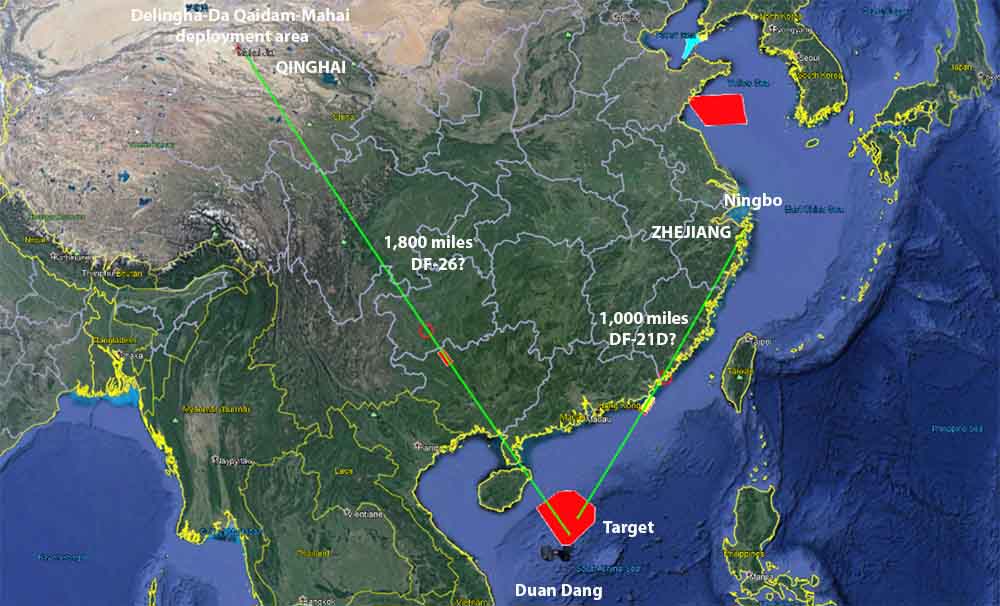
On August 26, two missiles were launched at an area in the South China Sea from Zhejiang and Qinghai. This was seen by many outlets to be an escalation in regional tensions, while Chinese state media downplayed it as a nominal exercise – pointing to the actions of a US spy plane from two days before as a more incendiary instigation.
The missile launched from Qinghai was reportedly a DF-26B, while the one from Zhejiang was a DF-21D. With both being part of the Dongfeng family of missiles (dong feng literally meaning ‘east wind’), the DF-26 has a considerable range of 4,000 km (as reflected by its launch from China’s deep interior) and the DF-21 is of a shorter range but is described to be significantly more advanced in its precision and in-flight target adjustments. The latter is unsurprisingly the one with the ‘carrier-killer’ moniker.
The launches came two days after an American U2, a Cold War-era reconnaissance aircraft, allegedly disrupted a military exercise in northern China by entering an area earlier declared to be a no-fly zone. China’s Ministry of Defense called this an “act of naked provocation”.
One day later on August 27, Beijing announced it was conducting another live fire exercise in waters off the coast of Zhejiang, bringing the number of drills off its coast from the past week to five.
This is slightly different from both sides simply poking at each other with a stick. It is both sides reminding each other of how long their sticks can reach.
Flying a U2 close to a “military exercise in northern China” – which would realistically be near the coasts of either Shandong or Liaoning – would be relatively commonplace even if bilateral tensions were significantly warmer than they have been over the past year. A chance to take a closer observation of the rapid maturation of the PLA would not go unspent by the US, and if the aircraft truly did disrupt an ongoing exercise, its intent would be to send the message that the US can maintain a watchful eye on the PLA whenever it deems necessary. The Ministry of Defense would be correct in its reaction, as in its core essence, the flight is a direct subversion of Beijing’s interpretation of regional security.
For the missile launches, the purpose of utilizing these two types in particular would be to send a bold warning in response to the concurrently-held RIMPAC excercises. The DF-26, as the FT points out, has been called the ‘Guam Express’ on Weibo due to its ability to hit US assets in the territory of Guam. Paired with the DF-21’s touted potential to mitigate the US Navy’s carrier-based superiority in the East and South China Seas, the launches act as an astute reminder of China’s ballistic inventory.
While the presence and estimated capabilities of the DF missiles are far from unknown by the US and its allies, it is unlikely that precise or plentiful data is readily available on them. As such, the choice to go ahead with the launches also indicate a significant degree of confidence on part of the PLA: with the presence of US intelligence known to be nearby, China openly gave live details of these missiles to every observer in the region, such as the nuances of each missile’s pull-up and gliding phases – never mind their respective speeds and minimum ranges.
All things considered, the balance of hard power in the Western Pacific largely favors the United States but has steadily inched towards China in recent years with the dramatic pace of its naval modernization. Despite still being far from possessing regional supremacy, the PLA is likely the most confident in its maritime capabilities than it has ever been. The US is cognizant of this, and will react by continuing to match China’s boldness.
Sources and Further Reading
Financial Times: Chinese military drill ratchets up tension with Washington

South China Morning Post: Chinese military fires ‘aircraft-carrier killer’ missile into South China Sea in ‘warning to the United States’
 The Constant