I. The Curious Case of Hambantota, Sri Lanka
In a sweltering heat and humidity that shies from the changing of the seasons, Sri Lanka’s rural southern region of Hambantota is known for its rich wetlands and boisterous elephants. Emerging by the waters in recent years, however, is a project of intense ambition.
In Hambantota’s southern port, there stands a shared yet separate hope for two nations. For Sri Lanka, the development of Hambantota marks a major step forward in the advancement of the historically underdeveloped region; a region that was hit especially hard by the Indian Ocean tsunami thirteen years ago. For China, the port exists as a major stepping stone in its Maritime Silk Road strategy, an initiative by Chinese president Xi Jinping that aims to link together Chinese holdings and investments throughout South Asia, Africa and Europe. However, in this junction of national interests, very little has gone according to plan. The case of Hambantota has only inhibited – and in some respects – even backfired upon the ambitions of both countries.
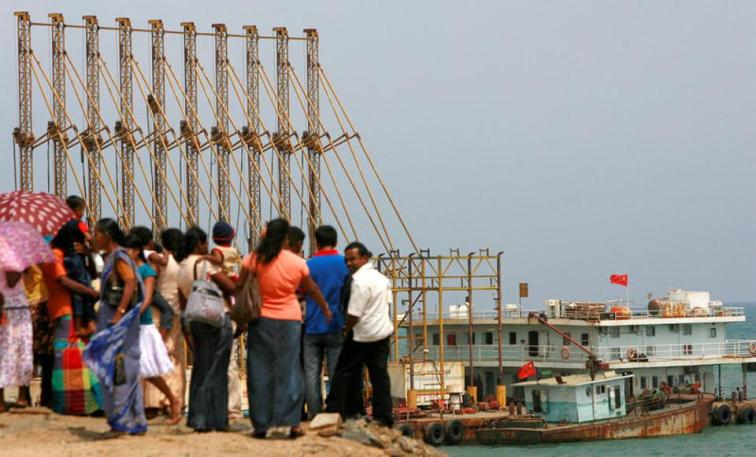
When Sri Lanka’s former president Mahinda Rajapaksa sought out to revitalize the district of Hambantota (where he himself hails from) he refused to let himself think small. Included in his aspirations were an international airport, a world-class cricket stadium, modern high-rises, an entire infrastructural overhaul, and a massive deep sea port. Yet as is a common case with big dreams, they also tend to require big money. To finance the immense projects, Rajapaksa drew the audience of Chinese banks and investors, who in total, gave US $8 billion in soft loans to Sri Lanka.
The central caveat to the ambitions of Sri Lanka in Hambantota is that this is a region that sees the migration of elephants, a place where wildlife intersects with attempts at human development. In essence, Sri Lanka and China sought to build a multi-billion dollar city at the edge of a jungle. Such a development might be even more ambitious than China’s establishment of Shenzhen as a Special Economic Zone – especially considering the initially expected timescale of a mere handful of years.
Even with a tremendous amount of money behind it, the advancement of the city has thus so far struggled, instead producing only empty buildings with little utilization of the airports, stadiums and highways that have been constructed. As a result, there have been comparisons drawn from observers to China’s ghost cities of the past. But unlike the case of China where many settlements were eventually filled out due to the shifting landscape of housing demand, there exists no such prospect in Hambantota.
This tenuous phase in Hambantota’s development has added onto Sri Lanka’s descent into deep debt, a result of attempts to inject its economy with growth through the pursuit of large-scale infrastructure projects. According to Forbes, more than 90% of the government’s total revenue to repay is owed up to nearly US $60 billion – quite the backfire for initiatives that were meant to have the exact opposite result. With the prospects of direct monetary repayments looking gravely slim, the government sought to pursue debt/equity swaps, whereby they give a greater stake in these projects to China in exchange for eliminating debt. Yet in conjunction with the sharp downturn of Sri Lanka’s economy, the furor and malcontent of its citizens have only risen.
II. Changing Perspectives of China Abroad
Around the time of China’s initial investments in Sri Lanka in 2010, there was an air of positivity in regards to the relationship between the two countries. Beijing provided Sri Lanka with arms and equipment to help finalize the latter stages of Sri Lanka’s twenty-five year long civil war, a crucial time when Western nations did not assist the Sri Lankan government. China was looked upon even more favorably, as they would also often side with the government whenever most foreign parties would often raise the issue of human rights. Amongst the majority ethnic Sinhala at the time, Sri Lankan-Chinese relations were seen as optimistic and mutually beneficial going into the future.

Within seven years, feelings have quickly changed. As more money was being pumped into large-scale projects, the administration of Sri Lanka’s former leadership was caught in a web of corruption surrounding its grand economic initiatives – such as the development of Hambantota. Even when the previous government was voted out of power, the murmurs of foreign entities being complicit in the corruption continued along as Sri Lanka spiraled deeply into debt to one country in particular – China.
Resentment against China has only intensified in recent times. With the government now unable to pay China back for large infrastructure projects that have yet to benefit Sri Lankans, whispers of neo-colonialism have grown louder and louder, coming from a country that holds deeply ingrained colonial memories. Colorful comparisons to the colonial East India Companies of the British, Dutch and Portuguese empires have been made to the Export–Import Bank of China (Chexim) and the China Merchants Port Holdings Company (CMPHC) by local outlets, and even if such comparisons are far-reaching and fanciful at best, the tiny notion of China acting as a modern imperialist power is a still a deeply intriguing line of thought.
Beijing undoubtedly holds a highly macro-oriented perspective when it comes to its general economic strategies beyond its borders. The Belt and Road and Maritime Silk Road initiatives were constructed (and presented) as harmonious and pragmatic plans that would be mutually beneficial for most of the countries involved, yet it would be unwise to assume that a touch of acrimony would not have appeared along the way. While some can point to Sri Lanka’s changed perspective on China as one that has its roots in xenophobia and the failures of its own government, this is a country that saw China as an essential partner less than a decade ago. Economic misfortunes may have brought upon a reversal of perspectives, yet this is not an outcome limited to just Hambantota or Sri Lanka.
Throughout the Indo-Pacific, China’s presence is being increasingly felt without any shortage or stoppage in the foreseeable future. If promising projects fall through, economic conditions sour, and China is the most visible target to blame, the harmonious rise that Beijing has so adamantly purported its intentions to have been may face more obstacles that anticipated. Lastly, if such situations deteriorate far enough, the prospect of unhappy clients countering China’s economic advances with a military presence of their own – or of others – may rise if left unaddressed.
III. Hard Responses with Hard Power
In September of 2014, two Chinese submarines publicly docked at a container terminal in Colombo, nearly coinciding with the visit of the Xi Jinping to the Sri Lankan capital. This sparked a flurry of reactions throughout the Indian Ocean, where China’s People’s Liberation Army-Navy (PLAN) was reported to have been seen since late 2013 in the form of nuclear and diesel-powered attack submarines. The audacity of the public appearance, in the eyes of some, marked a desire for the PLAN to use Sri Lanka as a critical point of entrenchment in the Indian Ocean.
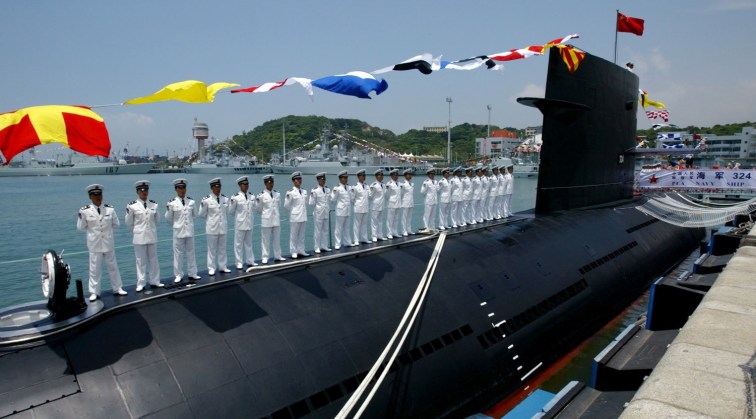
From the perspective of India, the fear is that if the PLAN can utilize China’s financial bearings over Sri Lanka to influence basing rights, China could exert an immense ability to gather intelligence and threaten Indian transshipment, from right off the coast of India. The PLAN would be able to be right in India’s face without the ability of the Indian Navy to respond in kind. From the perspective of the United States, not only would China’s territorial claims (and physical reclamations) in the South China Sea be a cause of concern, the prospects of having to face off with the PLAN even farther from the Western Pacific is a daunting one.
Recently however, it appears that the current Sri Lankan government is also not as inclined to be used as a stepping stone for China. This past February, Sri Lanka’s ambassador to Beijing made an adamant declaration that the PLAN would not be allowed to set up a military facility at any port in the country; nor would existing civilian facilities be allowed to used for military purposes. The basis of this, as the ambassador pointed to, was the concern of Sri Lanka’s neighbors over the potential presence of the PLAN in the Indian Ocean and any interference in international trade there.
While the ambassador mentioned that friendly joint exercises could always be held between Sri Lanka and China, he maintained that the country’s ports was to be used purely for unrestricted trade. This came just a few weeks after large clashes between government supporters and protesters erupted during a rally against the port in Hambantota, which local outlets described to be rooted in the unease of China’s financial influence over Sri Lanka.
A month later in March, the United States Pacific Fleet docked at Hambantota, in what was touted by official press statements as a humanitarian and disaster relief exercise. Done in conjunction with the naval forces of Sri Lanka, Australia and Japan, the choice of the participating nations, as well as the choice of docking at Hambantota gives the move a deeper security dimension. Despite technically not breaking the current government’s stance against militarizing the ports due to it being a joint humanitarian exercise, the presence of the naval forces of the United States, Australia and Japan (all nations with some form of stated grievance against China’s increasing military showings) was certainly one that was closely watched by Beijing. In addition, with Sri Lanka having been far more anti-American in the past, this development stands out as potential rebuke of Chinese influence.
In Summation
China’s attempt at a peaceful rise, no matter if it is genuine or not, cannot stay truly harmonious. As with the case of Hambantota, even massive investments from China’s side ended up reaping only incomplete benefits with an uptick in negative opinions on the side of Sri Lanka – a friendly partner just seven years prior. While it may be unlikely for every other government that China has dealings with in the region to fall into a disarray of corruption and debt, what the case of Hambantota shows is that economic conditions and advantageous relationships can deteriorate at almost a moment’s notice. As time goes on, the willpower to counterbalance China’s rise in the region – and perhaps even beyond – will only strengthen.
 The Constant